
Neuro-Luxury: Does Falling in Love With a Property Come Before Reason?

What if, in luxury real estate, the brain began choosing before the buyer consciously decided? When we encounter an exceptional property, just a few seconds can trigger a powerful emotional connection. Natural light, proportions, materials, perspective and even silence can shape our perception before rational analysis fully begins. Neuro-Luxury explores this fascinating intersection of neuroscience, psychology, architecture and desire, revealing why certain luxury properties become unforgettable — and why we can sometimes fall in love with a place before we even understand why.
When Emotion Moves One Step Ahead of Reason in Luxury Real Estate
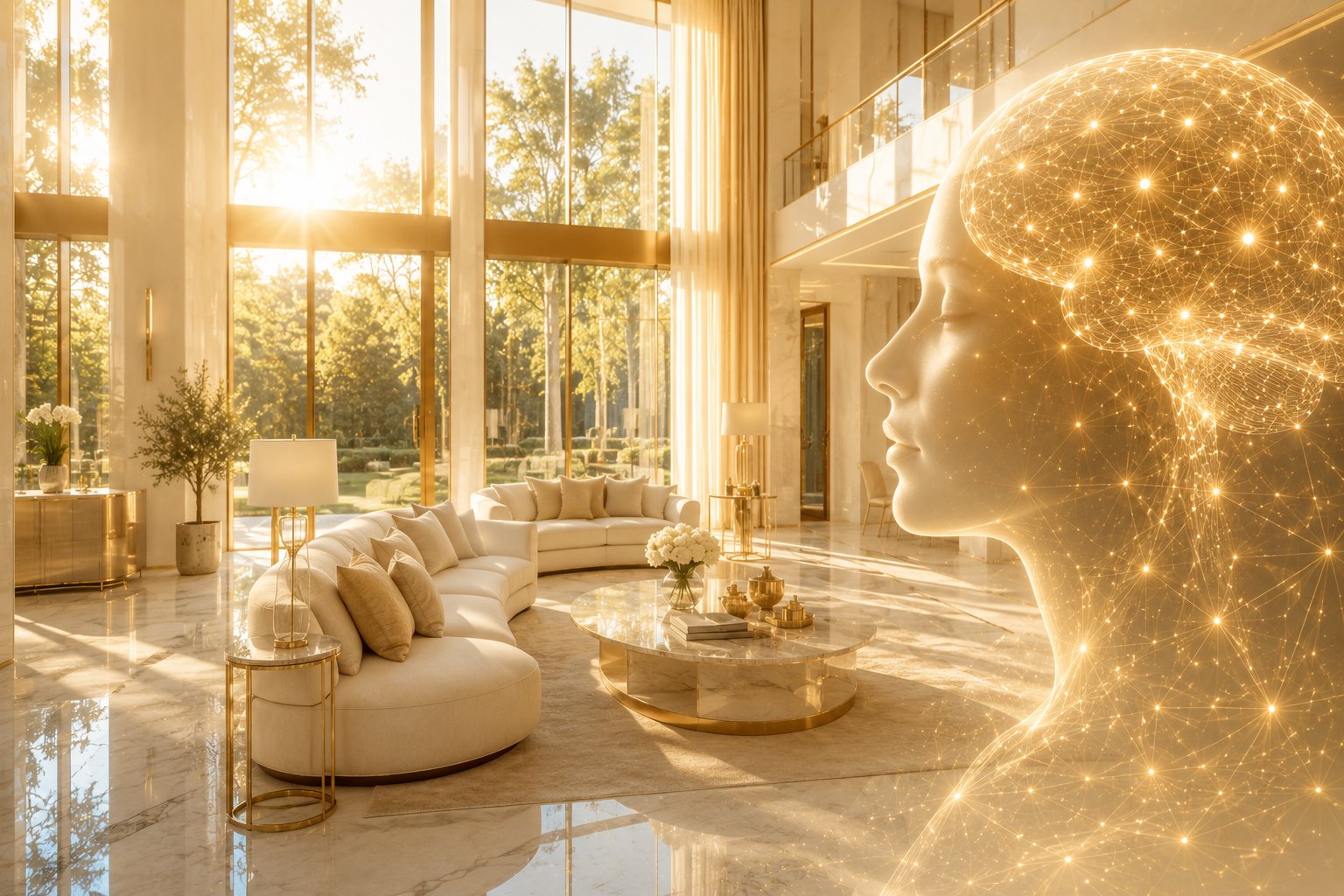 Why do certain properties trigger an emotional connection within seconds — before the buyer has even truly begun the visit?
This question lies at the heart of my thinking around Neuro-Luxury, at the intersection of psychology and more than 25 years of experience in luxury real estate.
Over the years, I have had the privilege of witnessing those rare, almost magical moments when, faced with an exceptional property, a client's expression changes, the criteria suddenly seem to disappear, and emotion moves one step ahead of reason.
Luxury real estate appears to be an intensely rational world: location, size, architecture, views, quality of materials, price and investment potential. Everything can be analysed, compared and valued.
And yet, sometimes, a few seconds are enough to overturn that hierarchy.
A client walks through a door.
They slow down.
Their expression changes.
They cannot yet explain what they are feeling — but something has already happened.
We call it falling in love with a property.
The expression itself is revealing. We never speak of “falling into reason.”
Intuitively, we seem to recognise that sometimes we feel before we can explain.
Scientifically, of course, opposing the heart and the brain would be misleading. Emotion, intuition, perception and reasoning are all part of the brain's extraordinarily complex processing system.
The more interesting question is therefore this:
Can emotional and perceptual processes influence our preferences before deliberate reasoning has completed its analysis?
And another, perhaps even more provocative, question follows:
Could falling in love with a property share certain psychological and neurobiological mechanisms with falling in love with a person?
This is the territory I explore through Neuro-Luxury: the meeting point between architecture, perception, memory, emotion, desire and decision-making.
Because in luxury real estate, almost everything can be measured.
Except, perhaps, what we feel.
The Day I Saw a Billionaire's Eyes Light Up
For me, Neuro-Luxury did not begin as a theory or a marketing trend.
It grew out of what I experienced, felt and observed during more than 25 years working with luxury real estate clients.
My profession has given me a rare privilege: the opportunity to observe millionaires, billionaires and international high-net-worth individuals at close range as they encounter exceptional properties.
And these observations have always had a particular resonance for me.
Because before luxury real estate, there was another passion: psychology.
With a doctorate in psychology, I have always been fascinated by the mechanisms behind human behaviour.
Why do we desire certain things and remain indifferent to others?
Why can an emotion completely transform a decision?
Why can two people look at the same object, the same work of art or the same property — and experience something entirely different?
For many years, psychology and luxury real estate existed as two separate worlds in my professional life.
Today, Neuro-Luxury finally allows me to bring these two passions together: psychology and luxury.
And when I look back at my years working with an international affluent clientele, certain moments take on an entirely new meaning.
One in particular has never left me.
A Castle They Had Never Chosen
A billionaire client featured by Forbes, his highly demanding wife and their young child were looking for a château in Normandy.
I prepared a selection for them.
They chose four properties to visit.
But they did not choose the château I had chosen for them.
On the day of the visits, almost everything seemed to be going wrong.
Rain.
Wind.
Grey skies.
One château followed another.
Nothing.
No excitement.
Their child was tired and crying. His parents were exhausted too.
Eventually, they told me they wanted to stop the visits and return to Paris.
I insisted — gently, but firmly.
“One more château.”
My client looked at me, exhausted.
“You're wasting your time.”
I knew that pushing harder would be a mistake.
So I used a little diplomacy.
“It's on the way…”
That was not entirely untrue.
Let's simply say that I very much wanted our route to pass through that particular place.
They had not selected the château.
But I had selected it for them.
At the time, I had only recently entered the profession.
I could not yet speak about the professional intuition that develops after years of observing clients — their reactions, silences and sometimes unspoken desires.
It felt more like a sixth sense.
I could not explain why, but something told me I absolutely had to show them this property.
More than 25 years later — and looking back through the eyes of a psychologist — I sometimes wonder what I had perceived without consciously knowing it.
Their personalities?
Their reactions to the previous properties?
The way they spoke about the life they imagined?
A desire they themselves had never clearly articulated?
Perhaps what we sometimes call a “sixth sense” is simply the brain understanding something before we have found the words for it.
So we continued.
Through the rain.
The château door opened.
My client stepped into the entrance hall.
And then I saw something I have never forgotten.
His eyes changed.
The eyes of a billionaire accustomed to almost everything — someone capable of buying almost anything and perhaps already somewhat blasé about the exceptional — suddenly lit up like those of a child.
He had not visited anything yet.
Not the reception rooms.
Not the bedrooms.
Not the park.
He had simply crossed the threshold.
He looked around and said:
“It's mine.”
A few seconds.
That was all it took.
And at that moment, something extraordinary happened:
our two intuitions met.
I had somehow “felt” his château before I could explain why.
He had somehow “recognised” it before he had even visited it.
Throughout my career, I have been fortunate enough to witness similar moments several times.
Men and women who are extraordinarily rational in business — accustomed to numbers, negotiations and major financial decisions — suddenly surprised by their own emotions.
People who have travelled extensively, seen almost everything, owned extraordinary things and become increasingly difficult to impress.
And yet, under certain circumstances, sophistication, experience and carefully defined criteria can suddenly give way to an almost childlike emotion.
Looking back at those moments is where my background in psychology and my experience in luxury finally began to converge.
What really happens in our brain when a property, a work of art, a hotel or an exceptional object produces an immediate emotional response?
Why do some places leave us completely indifferent while others seem to reach us before we can explain why?
This intersection between professional experience, human behaviour and psychology became the foundation of my thinking around Neuro-Luxury: an attempt to understand, through psychology, neuroscience and neuroarchitecture, what luxury professionals have often observed — and intuitively felt — for decades.
Because that day in Normandy, I did not simply watch a billionaire choose a château.
I watched emotion move one step ahead of analysis.
And more than 25 years later, one question still fascinates me:
What had his brain perceived during those few seconds that his conscious reasoning had not yet had time to formulate?
Why Do We “Fall in Love” With a Property?
The expression itself deserves attention.
In real estate, as in romantic relationships, we rarely describe a powerful attraction as a triumph of rational analysis.
We speak about falling in love.
The metaphor is beautiful, although scientifically imperfect: the heart does not make decisions independently of the brain.
Emotion, intuition, perception and reasoning all belong to a complex interaction between brain and body.
But the expression captures our subjective experience remarkably well:
we can feel a preference before we know how to explain it.
This question extends far beyond real estate.
We have already explored it through artificial intelligence, art and emotion: if a work of art moves us deeply, how much of its value comes from its creator — and how much comes from what it awakens inside us?
This is precisely where Neuro-Luxury becomes interesting.
Instead of studying only the object, artwork or property, we begin to study the human response it produces.
When Emotion Comes Before Justification
When we enter a property, our brain does not begin by mentally completing an Excel spreadsheet.
Within moments, it is processing countless signals:
light, proportions, volumes, perspectives, materials, sounds, scents, connection with the outdoors, memories, feelings of safety, familiarity and our ability to imagine ourselves there.
And sometimes, something shifts.
The property is no longer simply beautiful.
It becomes desirable.
Once that preference has emerged, another phenomenon may begin: we start constructing a rational explanation for it.
The property is, after all, at a perfectly acceptable distance.
The renovation work?
Perhaps not as significant as it initially appeared.
The price?
There must be good arguments to justify it.
And that extra bedroom which had previously been described as “absolutely essential”?
Perhaps we can live without it after all.
The mechanism feels strangely familiar in romantic relationships.
We can become remarkably creative when explaining — both to ourselves and to others — why the object of our affection is, ultimately, an entirely reasonable choice.
Does the Brain Find Arguments After It Has Chosen?
Cognitive psychology offers an interesting concept here: motivated reasoning.
It describes the way our motivations, preferences or desired conclusions can influence how we search for, select and evaluate information.
In other words, we are not always perfectly neutral judges who examine all the evidence before reaching a conclusion.
Sometimes we prefer first — and then become the lawyers defending our own preference.
In luxury real estate, this distinction matters.
It does not mean that an emotional reaction is irrational or that it necessarily leads to a poor decision.
Quite the opposite.
Human perception can rapidly integrate enormous quantities of information before our conscious mind has translated those signals into words.
What we call intuition may sometimes reflect fast processing shaped by previous experiences, memories and preferences.
Neuro-Luxury therefore does not seek to place emotion and reason in opposition.
It asks something more subtle:
In what order do they intervene, how do they interact, and how do they jointly construct our perception of value?
Which leads to a fascinating possibility.
What if, during a genuine real estate coup de cœur, we do not begin by deciding why we want the property?
What if we want it first — and only then begin to understand why?
That day in Normandy, my client had not yet seen the bedrooms, reception rooms or park.
He had just entered the hall.
His eyes lit up.
“It's mine.”
The emotional preference seemed to have already formed.
Reason had the rest of the visit to find its arguments.
Has Our Brain Already Started Choosing?
Before consciously listing the advantages and disadvantages of a property, our brain is already processing multiple forms of information:
light, volumes, perspectives, materials, sounds, distances and the body's relationship with space.
Neuroscience has identified several brain systems involved in how we perceive and represent places, while research in environmental psychology has explored the relationship between space, memory, emotion and identity.
Neuroarchitecture takes the question further.
Research by Oshin Vartanian and colleagues published in the Proceedings of the National Academy of Sciences has examined how architectural characteristics — including contour — can influence aesthetic judgments and approach-avoidance responses. Other studies have explored the effects of ceiling height and openness.
This does not mean that a curved wall or a high ceiling automatically creates desire.
But it reinforces an important idea:
we do not merely look at spaces. We react to them.
From “It's Beautiful” to “I Want It”
 In luxury real estate, the distinction is fundamental.
A buyer can admire ten exceptional properties without wanting to own any of them.
Then one appears that triggers something different.
“It's beautiful” becomes “I want it.”
Research by Kent Berridge and Terry Robinson distinguishes between two dimensions of reward: “liking”, associated with pleasure, and “wanting”, associated with motivation and the desire to obtain something.
Applied cautiously to real estate, the distinction raises a fascinating question:
At what point does a property stop being something we simply appreciate and become something we want to possess?
In luxury, this boundary matters even more because the value of an exceptional asset is not necessarily limited to financial performance.
As we explored in our analysis of the return of tangible assets in the investment strategies of wealthy individuals, heritage, rarity, transmission, experience and emotion can coexist within the same acquisition decision.
When a Property Becomes “Home”
The next shift is even more revealing.
The client begins saying:
“That's where I would put my desk.”
“We could have dinner outside.”
“My painting would look perfect on that wall.”
They are no longer simply visiting somebody else's property.
They have started mentally living there.
Environmental psychology has long studied place attachment, where space, memory, identity and belonging intersect.
Light, the scent of wood, a garden or even the sound of gravel beneath our feet can activate personal associations without our immediately knowing why.
The property becomes more than an asset.
It becomes a possible life.
Perhaps we never look at a home solely for what it is.
We also look at the life we could live there.
And what if, somewhere among our collection of exceptional châteaux and estates, your own “It's mine” moment is waiting?
Discover this remarkable Louis XIII-style château in Normandy.
Or perhaps you would prefer a château that already carries its own story.
In the Loire Valley near Tours, this 15th-century château set within a 100-hectare estate combines heritage, nature, mystery and legend.
A property said to have welcomed Joan of Arc — and perhaps simply waiting for its next story to be written.
Real Estate and Love: Is It Really the Same Kind of Attraction?
The comparison is tempting, but precision matters.
There is currently no scientific basis for claiming that falling in love with a property and falling in love with a person are the same neurobiological phenomenon.
They may, however, share certain dimensions:
attention → emotion → reward → memory → desire → projection → attachment
Neuroaesthetics adds another piece to the puzzle.
Research by Ishizu and Zeki has shown that subjective experiences of beauty have measurable neural correlates.
A person may attract us before we understand why.
A work of art may move us before we know its history.
A property may affect us before we have even calculated its square footage.
This connects directly with our exploration of artificial intelligence, art and emotion:
Does emotional value depend only on what we are looking at — or also on what it triggers within us?
This is one of the central questions of Neuro-Luxury.
How Light and Nature Change the Experience of Luxury
 That day in Normandy, one final detail made the scene almost surreal.
After hours of rain, the sun appeared.
Light flooded through the château and illuminated the park.
Of course, the sunshine had not “validated” my client's decision.
But it transformed our experience of the property.
The relationship between environment and well-being has been studied extensively in environmental psychology.
As early as 1984, Roger Ulrich's well-known study published in Science observed, within a specific hospital context, better postoperative indicators among certain patients whose rooms overlooked trees rather than a brick wall.
For luxury real estate, the broader reflection is important.
Views, natural light and connection with nature are not merely selling points.
They are part of the experience of a place.
This is also one of the transformations we are seeing with Wellness & Slow Luxury: contemporary luxury is no longer defined solely by more square metres or more visible signs of prestige.
Increasingly, it is associated with calm, natural light, nature, privacy and the quality of time itself.
We explored this evolution further in Mauritius or Marbella: Where to Invest in Luxury Real Estate in 2026?, where two interpretations of luxury meet:
connectivity, performance and liquidity on one side;
Slow Luxury, wellness, nature and quality of life on the other.
Neuro-Luxury invites us to go one step further.
Beyond comparing destinations, markets and investment metrics, it brings us back to personal experience.
Because between two destinations, two architectural styles or two landscapes, the final choice may ultimately be the place where we can most immediately imagine ourselves living.
Want to experience the difference?
Discover an exceptional villa in Mauritius, surrounded by golf, ocean and nature, or explore a contemporary villa in Marbella, combining Mediterranean architecture, natural light and lifestyle.
Two properties.
Two interpretations of luxury.
And perhaps, somewhere between them, your next coup de cœur.
This evolution suggests a new way of understanding luxury real estate.
Beyond rarity, address and patrimonial value, the experience itself is becoming a form of value.
And this may be where Neuro-Luxury opens a new territory:
understanding not only why we admire certain places, but why we want to experience them.
FAQ: Neuro-Luxury and Emotional Decision-Making in Luxury Real Estate
What Is Neuro-Luxury?
Neuro-Luxury explores how psychology, neuroscience, perception and environment can help us better understand the human experience of luxury.
In real estate, it considers how factors including architecture, natural light, spatial volumes, nature, memory and emotion may influence our perception of a property and the subjective value we attribute to it.
Why Do We Fall in Love With Certain Properties?
A real estate coup de cœur — that instant feeling of falling in love with a property — can emerge before we have even completed a rational analysis.
The heart does not literally make the decision instead of the brain. Perception, emotion, intuition and reasoning belong to a complex system.
But a preference may emerge before we can consciously explain all the reasons behind it.
Is Falling in Love With a Property Similar to Falling in Love With a Person?
There is no scientific evidence demonstrating that attraction to a property and romantic love are the same neurobiological phenomenon.
They may nevertheless share certain psychological dimensions, including attention, emotion, reward, desire, memory, projection and attachment.
This similarity is precisely what makes the comparison so interesting from a Neuro-Luxury perspective.
Why Do Some Luxury Properties Trigger an Immediate Emotional Response?
Our brains process numerous environmental elements extremely quickly:
light, proportions, perspectives, materials, sounds and connection with nature, alongside memories and personal associations.
Neuroarchitecture and environmental psychology explore how such characteristics can influence our perception and experience of a place.
What Is the Difference Between Finding a Property Beautiful and Wanting to Buy It?
Reward neuroscience distinguishes between “liking” — appreciating or enjoying something — and “wanting”, the motivation to obtain it.
The distinction is particularly interesting in luxury real estate.
A buyer may admire many extraordinary properties without wanting to own them.
The decisive shift occurs when:
“It's beautiful” becomes “I want it.”
Could Neuro-Luxury Transform Luxury Real Estate?
Neuro-Luxury does not replace real estate expertise or fundamental criteria such as location, rarity, architectural quality, price and patrimonial value.
It introduces another dimension:
the human experience of the property.
In a market where the world's most demanding clients already have access to almost everything, a property's ability to create well-being, emotion, attachment and lasting memories could become an increasingly important form of differentiation.
Conclusion: From Emotional Connection to Neuro-Luxury
 More than 25 years after that rainy day in Normandy, I can still remember the expression on my client's face when he walked through the château door.
He had not seen anything yet.
A few seconds had been enough.
“It's mine.”
At the time, I had neither neuroscience nor the concept of Neuro-Luxury to help explain what I had just witnessed.
Today, we understand that our relationship with places involves far more than aesthetic appreciation.
Perception, memory, emotion, desire, projection and attachment all contribute to the experience.
But Neuro-Luxury is not about reducing emotion to a scientific formula.
Nor is it about pretending that one day we will be able to manufacture a coup de cœur on demand.
It asks a much more interesting question:
What if the next frontier of luxury were not simply what we can see, measure or possess — but what the experience of luxury makes us feel?
Location, rarity, architecture, craftsmanship and patrimonial value will remain essential.
But in a world where the wealthiest clients already have access to almost everything, the real rarity may increasingly be the ability to feel something extraordinary.
Perhaps this is ultimately what Neuro-Luxury represents:
a shift from the value of the object to the value of the experience.
From:
“How much is it worth?”
to:
“How does it make me feel?”
And perhaps this is also why, more than 25 years later, I remain fascinated by luxury real estate.
We can measure square metres.
We can value a château.
We can calculate investment returns.
We can compare a property's price with the market.
But we still cannot put a price on those few seconds in which someone falls in love with a place.
And you?
I am convinced that almost every experienced real estate professional carries at least one slightly magical story with them.
What is yours?
And perhaps your next coup de cœur is already waiting somewhere within the Luxury World For You collection.
The only way to find out is to discover whether, among these exceptional properties, there is one capable of making you forget your criteria — even if only for a few seconds.
At Luxury World For You, we believe that tomorrow's luxury will no longer be defined solely by rarity, value or prestige, but also by the emotions it creates, the memories it leaves behind and its ability to improve the quality of our lives.
This conviction inspires our editorial approach, our selection of exceptional properties and our exploration of Neuro-Luxury: understanding not only what we choose, but why certain places, objects and experiences affect us so deeply.


