
NEURO-LUXURY: AFTER THE BIRKIN BAG, COULD EMOTION BECOME THE NEW LUXURY?

Luxury is entering a new era — one in which value is defined not only by what we own, but increasingly by what we feel. From the Birkin bag and luxury wellness to exceptional real estate, art and artificial intelligence, Neuro-Luxury explores how emotion, desire, surprise and the unexpected are emerging as new forms of scarcity in the future of luxury. With LWFY PRIVÉ and FIVE, Luxury World For You takes this thinking beyond theory, creating rare experiential luxury moments designed not to dictate emotion, but to create the conditions in which it can emerge.
FROM THE LUXURY WE OWN TO THE LUXURY WE FEEL
For decades, luxury was defined by what we could own: a rare watch, an exceptional car, a work of art, a prestigious property or an iconic handbag. Scarcity, craftsmanship and exclusivity turned these objects into powerful symbols of status and desire.
The Birkin bag remains perhaps the ultimate expression of that model: instantly recognisable, notoriously difficult to obtain and desirable precisely because access has never been entirely straightforward.
But the luxury market is changing.
As exceptional products become more visible, more photographed and more widely shared, a different form of scarcity is beginning to matter — particularly in the worlds of ultra-luxury and experiential luxury.
It is the scarcity of what cannot be easily reproduced, standardised or displayed.
An emotion.
A sensation.
A memory.
A desire we did not even know we had.
Could luxury therefore be moving from “what I own” to “what I feel” — and ultimately to “what it awakens in me”?
For luxury consumers who already have access to almost everything, material exclusivity may no longer be enough. The next frontier of luxury could lie in something far more personal: the ability to create genuine emotion, unexpected desire and experiences that cannot be replicated.
This is the territory of Neuro-Luxury — at the intersection of luxury, psychology, emotion and desire.
And it raises a larger question about the future of luxury:
In a world where almost everything is becoming accessible, visible and reproducible, could true rarity ultimately be what we are still capable of feeling?
Explore the idea further →
Neuro-Luxury: Why Emotion Could Become Luxury’s New Scarcity
WHEN EXPERIENCE REDEFINES THE VALUE OF LUXURY
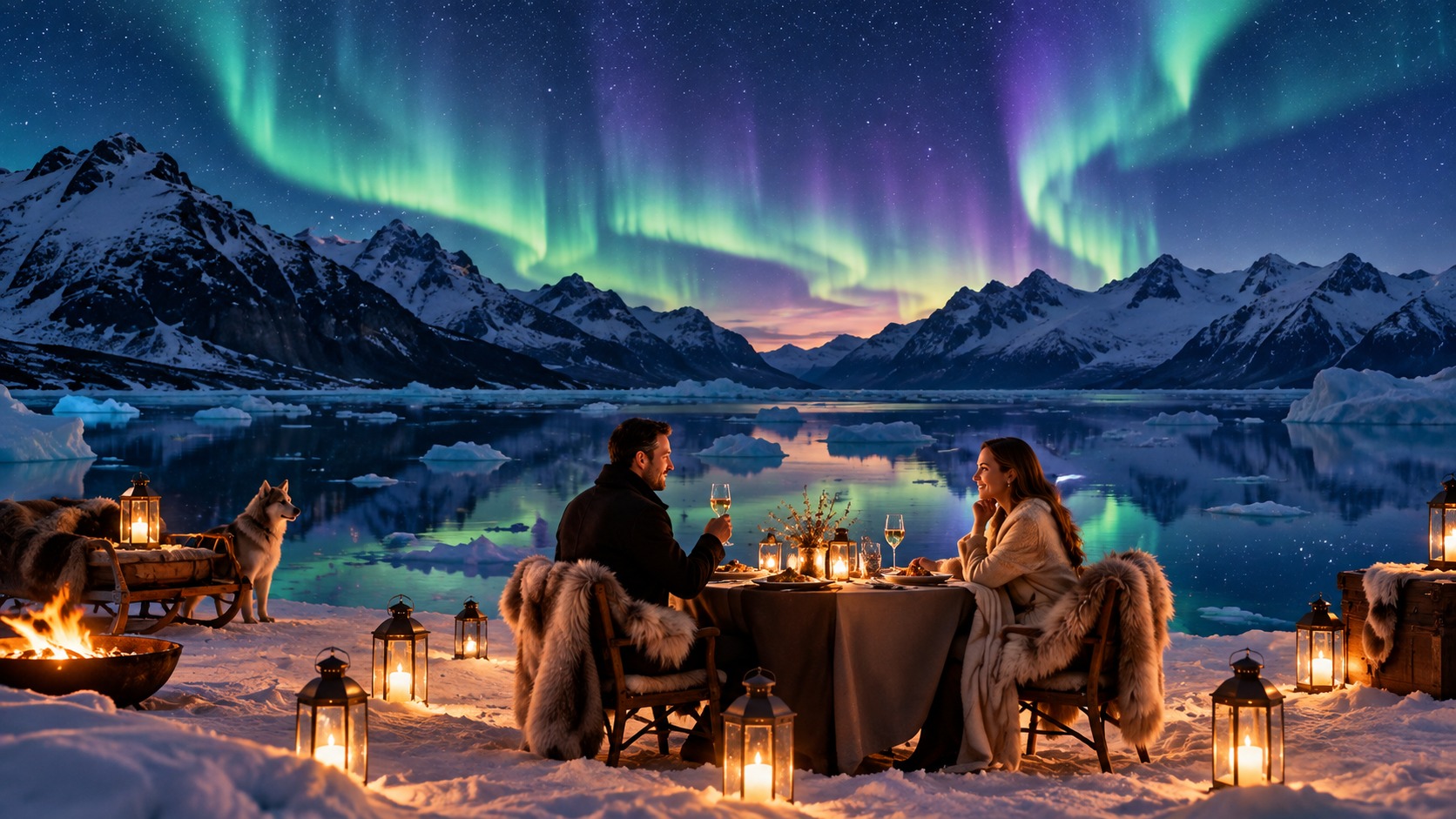 Traditional luxury is not disappearing. High jewellery, collectible cars, fine art, iconic maisons and exceptional real estate will continue to inspire desire and remain central to the global luxury market.
But for clients who can access almost anything, owning more does not necessarily mean feeling more.
This is where a deeper shift is emerging. In the world of ultra-luxury, value is increasingly shaped not only by rarity, craftsmanship or price, but by the ability to create a personal, memorable and difficult-to-reproduce experience.
For high-net-worth and ultra-high-net-worth individuals (HNWIs and UHNWIs), the ultimate privilege may therefore be shifting from access to more things towards access to something they have never experienced — or felt — before.
This evolution is helping drive the rise of experiential luxury, where exclusivity is measured not only by what few people can own, but increasingly by what few people can experience.
THE NEW SCARCITY: WHAT CANNOT BE REPRODUCED
Staying somewhere inaccessible to conventional tourism, dining in a private residence normally closed to the public, meeting an artist in their own world, spending several days in a secluded château, or experiencing something conceived entirely around one individual — these experiences share one essential characteristic:
They can never be reproduced in exactly the same way.
An object can be preserved, collected, resold or passed down. An experience exists fully only in the moment in which it is lived.
And even when repeated, it never produces precisely the same emotion.
In a luxury market where material perfection is increasingly accessible to the world’s wealthiest consumers, the irreplaceable acquires a new value.
The inability to fully reproduce a moment, a sensation or an emotion may therefore become one of the defining forms of exclusivity in contemporary luxury.
WELLNESS: A NEW FRONTIER FOR LUXURY
This search for new emotions and sensations coincides with another major transformation of the luxury market: the rise of wellness, longevity and highly personalised wellbeing experiences.
Private retreats, destination spas, sleep optimisation, nutrition, meditation, digital detox and immersive experiences are becoming increasingly prominent across luxury hospitality and experiential travel, particularly among high-net-worth and ultra-high-net-worth clients.
The logic is compelling.
In a world saturated with information, stimulation and screens, calm itself has become a form of scarcity. The ability to stop, sleep deeply, breathe, reconnect with nature or simply escape constant stimulation can now represent a genuine privilege.
This shift is increasingly reflected in the destinations and properties people choose.
At Mandarin Oriental Marrakech, spa, nature and art de vivre come together to create an experience designed as much around emotional wellbeing as physical comfort.
At Amanpuri and its Private Wellness Sanctuary, privacy, tropical nature and personalised programmes turn a stay into an opportunity for deeper reconnection.
Yet the growing luxury wellness movement also raises a more nuanced question: does wellbeing always mean slowing down?
WELLBEING DOES NOT ALWAYS MEAN CALM
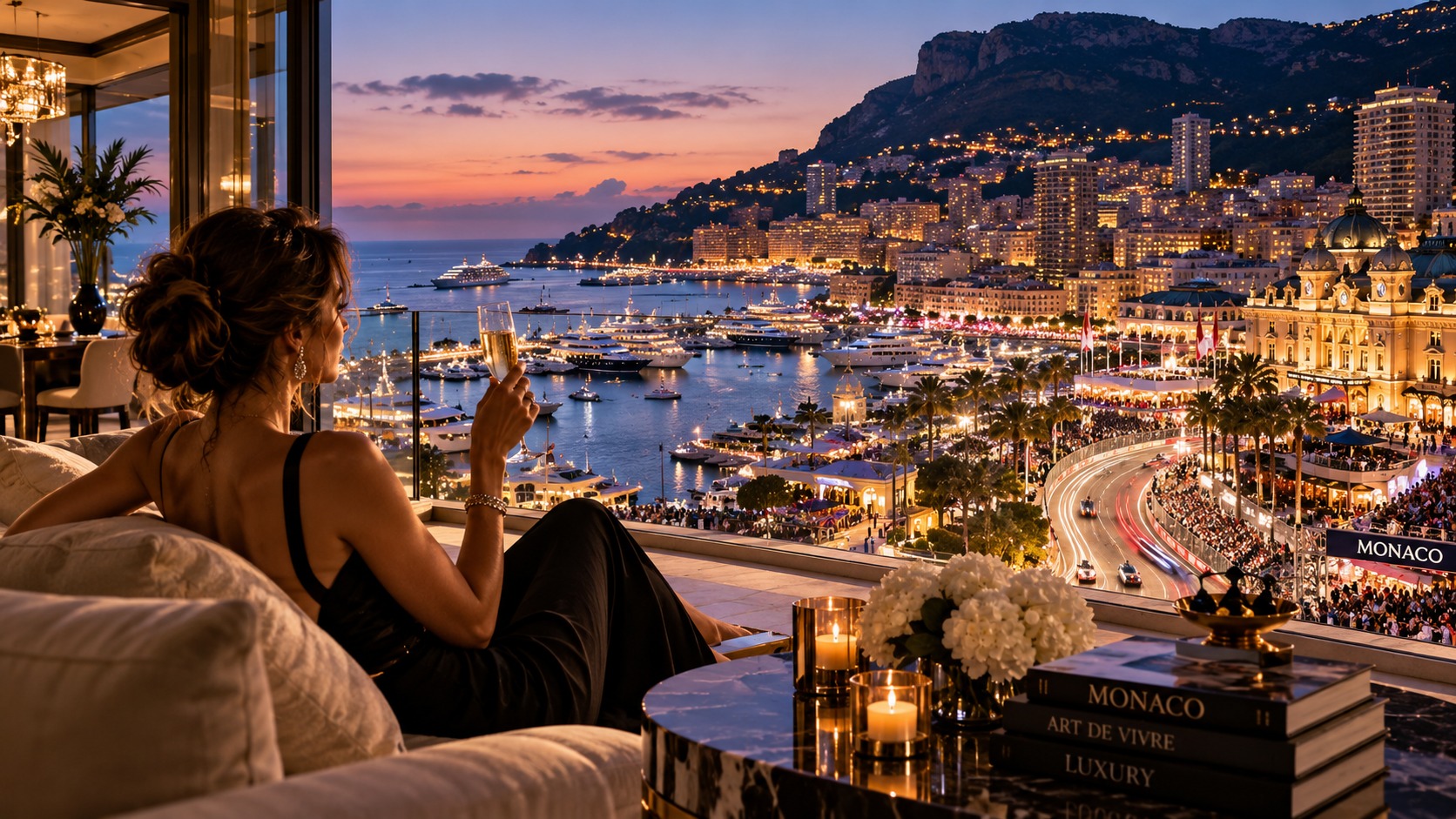 We instinctively associate wellness with tranquillity: slowing down, meditating, reducing stimulation and rediscovering silence.
Yet our emotional needs do not always move in the same direction.
Some people need calm. Others need to feel more: surprise, beauty, curiosity, desire, wonder — perhaps even intensity.
True wellbeing may therefore be less universal and far more personal: not necessarily about feeling less, but about rediscovering the emotional state we need at a particular moment in our lives.
And this is where the relationship between wellness and luxury real estate becomes particularly interesting.
A place affects us far beyond its square metres, architecture or address. Light, silence, the horizon, nature and history — or, conversely, the energy of a city — can profoundly influence the way we feel.
For some, the ultimate privilege may be retreating into dozens of hectares of nature, far from urban noise and pace — perhaps even sleeping within the walls of a 15th-century residence where Joan of Arc is said to have found refuge five centuries ago.
For another, it might be a penthouse overlooking Monaco, surrounded by light, architecture and the energy of the Mediterranean.
For someone else, a villa in Mauritius, opening onto the ocean, where the horizon becomes part of everyday life.
Three places. Three worlds. Three entirely different emotional responses.
There may be no single ideal environment for wellbeing.
Instead, there are places capable of responding to very different emotional needs.
This is precisely where wellness meets Neuro-Luxury: when we stop asking only, “What amenities does this place offer?” and begin asking, “How does this place make me feel?”
And the implications extend well beyond personal experience.
Luxury wellness, longevity, private retreats and Slow Luxury are becoming economic territories in their own right, attracting growing interest from investors, hospitality groups, developers and private capital.
What begins as a search for wellbeing may therefore be evolving into something larger: a new way of creating value across luxury hospitality, travel and real estate.
Explore the economic implications of this transformation →
Wellness & Slow Luxury 2026: Trends, Investment and Strategies of the World’s Wealthiest
NEURO-LUXURY: WHEN LUXURY MOVES BEYOND WHAT WE SEE
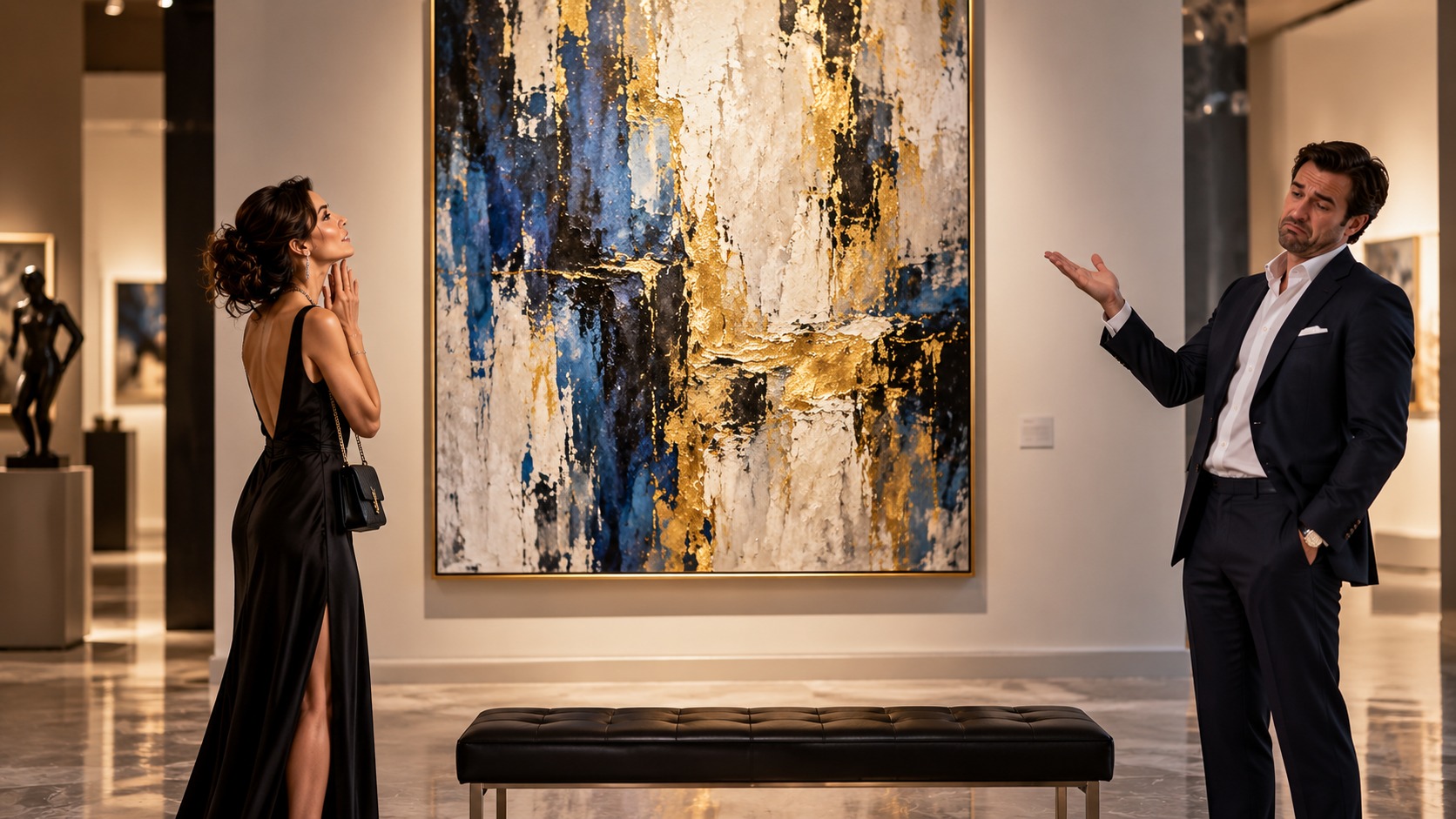 Neuro-Luxury begins with a simple idea: the value of a luxury experience lies not only in what we see, own or experience, but in what it triggers within us.
Two people can enter the same five-star hotel suite, stand before the same work of art or visit the same exceptional property — and experience entirely different emotions.
Why?
Because perception is personal. It is shaped by our memories, expectations, emotional state, previous experiences and the associations we bring with us.
This introduces an increasingly important question for the future of luxury: if exceptional quality becomes easier to reproduce, could emotional impact become one of the things that remains truly difficult to replicate?
WHEN PERFECTION IS NO LONGER ENOUGH TO CREATE EMOTION
Contemporary luxury has achieved an extraordinary degree of perfection.
Five-star hotels can deliver remarkably consistent standards of comfort across continents. Technology can create interiors of almost flawless precision. Service is becoming increasingly seamless and personalised.
Yet the more reproducible perfection becomes, the more another form of value begins to matter:
the irreplaceable.
An architectural imperfection carrying centuries of history.
A particular quality of light at a certain hour.
A scent that awakens a memory.
An unexpected conversation.
A work of art that unsettles us.
A silence we had forgotten existed.
These are often the details we remember.
And in an industry built around exclusivity, perhaps what stays with us is becoming as important as what impresses us.
IN LUXURY REAL ESTATE, WE BUY MORE THAN SQUARE METRES
This emotional dimension is particularly visible in luxury real estate.
On paper, two properties may appear remarkably similar: location, size, architecture, number of bedrooms, views, amenities and quality of renovation.
Yet one may leave a buyer perfectly rational.
The other can awaken a desire that did not exist before they walked through the door.
This is where property moves beyond specifications and becomes something more personal: a projection of another way of living.
LUXURY CAN ALSO CREATE A DESIRE THAT DID NOT EXIST BEFORE
I experienced this first-hand with a client who came to the French Riviera with a very precise intention: to buy a contemporary villa.
His brief was clear. His criteria were established. Nothing suggested that a château would interest him.
And yet, as the visits unfolded, something changed.
He ultimately did not leave with the villa he had come to find.
He left with two châteaux.
What happened between his initial intention and his final decision?
Technical specifications alone cannot explain it.
His desire had changed.
The properties had awakened his imagination and allowed him to project himself into a way of living he had never previously considered. In doing so, they revealed a desire that simply had not existed a few days earlier.
This is precisely where luxury real estate meets Neuro-Luxury.
The role of luxury is not necessarily limited to satisfying an existing demand. At its most powerful, it can also reveal a desire the client did not yet know they had.
For luxury professionals, this raises an interesting question about consumer behaviour and decision-making in high-end real estate. How much of an acquisition is driven by predefined criteria — and how much emerges only when a property creates an emotional connection?
Perhaps the true coup de cœur begins at exactly this moment: when we stop comparing what we see with what we thought we were looking for.
Why do some properties leave us perfectly rational, while others overturn within seconds every criterion we thought we had carefully defined?
This strange alchemy between emotion, desire and real estate decision-making lies at the heart of another Neuro-Luxury exploration: “Does Falling in Love With a Property Come Before Reason?”
THE CHÂTEAU: HERITAGE ASSET OR EMOTIONAL EXPERIENCE?
The château is particularly fascinating from this perspective.
Its value cannot be reduced to architecture, acreage, location or history.
A château introduces us to a different relationship with time: ancient stone, century-old trees, silence, nature, craftsmanship and sometimes even the beauty of imperfection.
In an accelerated world, this encounter with slower time can itself become a luxury experience.
A château can therefore be more than a heritage real estate asset. It can offer something increasingly difficult to find in contemporary life: distance from immediacy, continuity with the past and the possibility of experiencing a different rhythm altogether.
Heritage is no longer simply something to preserve.
It can become something to experience.
And perhaps even something capable of transforming the person who inhabits it.
What if tomorrow’s luxury were no longer simply about living in exceptional places, but about choosing those capable of transforming us, reconnecting us — and perhaps giving back something modern life has gradually taken away?
This is where heritage, experiential luxury and regenerative luxury begin to converge, opening a new way of thinking about the future of exceptional properties:
“21st-Century Châteaux: From Historic Heritage to Regenerative Luxury.”
ART AND LUXURY: WHEN EMOTION BECOMES MORE PRECIOUS THAN POSSESSION
Art may offer one of the clearest illustrations of the emotional dimension of Neuro-Luxury.
In the luxury art market, we often evaluate a work through familiar criteria: the artist, provenance, rarity, aesthetic significance and market value.
But beyond collecting and investment lies a far more personal question:
What effect does an artwork have on us when we actually live with it?
Certain colours may energise us. Certain compositions may invite contemplation. An image can awaken a memory, create an association or simply alter the atmosphere of a room — and perhaps our own emotional state within it.
An artwork we encounter every morning can gradually become more than something we own. It becomes part of our visual and emotional environment.
This distinction is important. The market can establish the financial value of an artwork. It cannot fully measure its emotional value to the person who lives with it.
WHEN A PAINTING AWAKENS SOMETHING WITHIN US
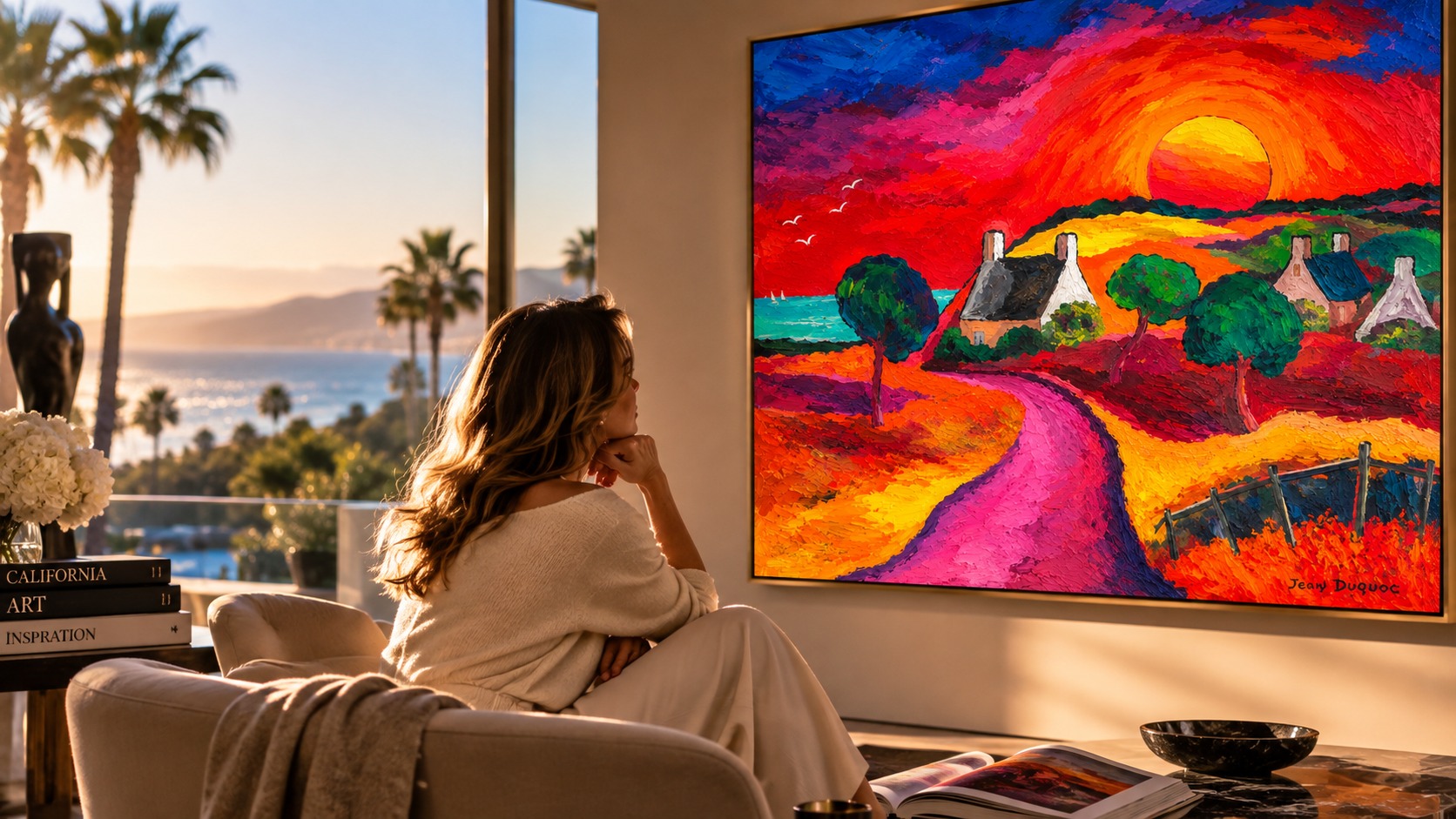 The story of Margo in California offers a striking example.
She was going through a difficult period in her life, following a separation and a period of low energy, when she discovered the paintings of Jean Duquoc — works characterised by powerful colours, expansive horizons, pathways and an almost physical quality of light.
Several paintings illustrate this emotional intensity particularly well.
“Une Matinée Jaune Complice du Soleil”, with its explosion of light and colour, seems almost to radiate energy beyond the canvas.
“Le Chemin Mauve”, through its contrasts and perspective drawing the eye towards the horizon, invites a more contemplative experience.
And “Vers l’Horizon” raises, almost literally, one of the questions at the heart of Neuro-Luxury: what is it within an image that can suddenly make us want to move forward, imagine somewhere else — or simply feel something?
Margo was not looking for therapy.
She had simply encountered paintings that spoke to her.
Yet she later described living with these works as having a positive emotional effect on her, as though their colours, light and energy had gradually reawakened something she felt she had lost.
This is, of course, a personal experience rather than a medical claim. Art does not affect everyone in the same way. A painting that profoundly moves one person may leave another entirely indifferent.
And that is precisely what makes the relationship between art and emotion so fascinating.
The emotional value of an artwork cannot be measured solely by what it represents, who created it or what the market says it is worth. It also lies in what it triggers in the person who lives with it.
For collectors, this introduces another dimension to the traditional relationship between art, luxury and investment.
The question is no longer simply:
“How much is this artwork worth?”
Or even:
“Do I find it beautiful?”
But perhaps also:
“How do I feel when I live with it?”
Some works decorate our walls.
Others become part of our lives.
And artificial intelligence makes this distinction even more intriguing.
As AI becomes increasingly capable of analysing aesthetic preferences, recognising patterns in our behaviour and generating images tailored to individual tastes, a deeper question emerges:
If AI learns to predict what we are likely to find beautiful, can it also create the inexplicable emotion that sometimes takes hold of us in front of a work of art?
The distinction matters.
Predicting preference is not necessarily the same as creating emotion.
And the space between the two may become one of the most fascinating frontiers at the intersection of artificial intelligence, art, luxury and human creativity.
We explore this question further in “Neuro-Luxury: Can Artificial Intelligence Move Us as Deeply as an Artist?”
AFTER THE ATTENTION ECONOMY, ARE WE ENTERING THE EMOTION ECONOMY?
For years, brands, platforms and digital ecosystems have competed for one increasingly valuable resource: our attention.
Notifications, social media, images, recommendations and an endless stream of content are designed to capture our gaze — and hold it for just a few seconds longer.
But abundance has created its own paradox:
we see more than ever, yet relatively little genuinely moves us.
Almost every experience can now become content: a restaurant, a journey, a hotel, a car, a work of art, an exceptional property or a landscape. Everything can be photographed, shared and visually reproduced.
But a photograph can show what we saw.
It can never fully communicate what we felt.
This may be where a new frontier for the luxury industry begins to emerge.
If the attention economy was built around capturing the eye, an emerging emotion economy would be built around something far more difficult to obtain: creating an experience that genuinely affects us.
When attention becomes saturated, authentic emotion itself becomes scarce.
And what is experienced privately — without necessarily being displayed, shared or validated by others — may paradoxically acquire greater value.
For luxury brands, hospitality groups, real estate professionals and experience creators, the implications could be significant.
Producing beautiful images and capturing attention may no longer be enough. The challenge will increasingly be to create something far harder to reproduce:
an experience that leaves an emotional trace.
NEURO-LUXURY: CAN AI CREATE DESIRE — OR COULD IT KILL IT?
At the same time, another transformation is reshaping our relationship with desire: artificial intelligence.
AI is becoming increasingly capable of learning our tastes, analysing our behaviour and anticipating our preferences. Through recommendation systems and increasingly sophisticated personalisation, it can reduce the distance between what we might want and what we are shown.
But is that really creating desire — or simply becoming extraordinarily good at predicting preference?
The distinction matters.
Human desire is not always rational, consistent or predictable.
We can be moved by an artwork that is not “our style”, fall in love with a property that matches almost none of our criteria, or suddenly want an experience we would never have thought to search for.
Between preference and desire lies a territory far more difficult to capture in data:
the unpredictable.
WHEN ABUNDANCE THREATENS DESIRE
Artificial intelligence introduces another paradox for the luxury industry: it makes an already extraordinary abundance of choice even easier to navigate.
Luxury real estate, art, hospitality, travel and experiences can increasingly be searched, compared, filtered and personalised within seconds, continually shortening the distance between “I want” and “I get”.
That efficiency creates enormous value.
But desire is not built on efficiency alone.
It can also be nourished by what resists immediate satisfaction: waiting, rarity, curiosity, discovery and mystery.
The Birkin remains an almost perfect symbol of this phenomenon. Part of its desirability lies not only in the object itself, but in the fact that access has never been entirely immediate or predictable.
This raises a strategic question for the future of luxury.
As AI makes discovery more seamless, selection faster and personalisation increasingly precise, could value begin to migrate towards something algorithms cannot entirely control?
The ability to surprise us — and awaken a desire we did not know we had.
The story of my client who came to the French Riviera looking for a contemporary villa and left with two châteaux illustrates this perfectly.
Data could describe what he thought he wanted.
Emotion revealed what he could desire.
This distinction may become one of the defining frontiers of Neuro-Luxury.
Yesterday, rarity was largely defined by what few people could possess.
Tomorrow, another form of rarity may emerge in what no algorithm can fully predict: the emotion that creates desire.
AI can anticipate our preferences.
Humans can still create the unexpected.
CAN WE DESIGN THE CONDITIONS FOR EMOTION?
If emotion becomes a new source of value in luxury, another question follows:
Can we create the conditions for emotion without trying to manufacture the emotion itself?
A place, a particular quality of light, silence, anticipation, an encounter, a surprise or a sudden change of rhythm can create the conditions for a personal response — without determining in advance what someone should feel.
This distinction is fundamental.
The objective is not to engineer a predetermined reaction, but to design an environment in which something unexpected still has room to happen.
This is what I call the emotional engineering of luxury.
Not programming emotion.
Designing the conditions in which emotion can emerge.
For the luxury industry, this could open a new field of thinking across hospitality, luxury real estate, art, travel and experiential luxury: moving beyond personalisation based solely on what clients already like, towards experiences capable of introducing discovery, surprise and emotional resonance.
In an age of increasingly precise algorithms, perhaps the most sophisticated form of personalisation will not be giving people exactly what the data predicts they want.
It may be creating the possibility of discovering something they never knew they wanted.
We explore this idea further in “Neuro-Luxury: The Emotional Engineering of the New Slow Luxury.”
LWFY PRIVÉ: WHEN NEURO-LUXURY BECOMES EXPERIENCE
If Neuro-Luxury explores how emotion, perception and desire can redefine the value of luxury, LWFY PRIVÉ is where that thinking moves from concept to experience.
Created by Luxury World For You, LWFY PRIVÉ is built around a simple idea: the future of experiential luxury may not lie in offering more, but in creating rare, highly personalised moments that cannot easily be reproduced.
A place.
An encounter.
A work of art.
A particular moment in time.
An element of surprise.
Each can become an emotional trigger — not because the emotion itself is predetermined, but because the experience creates the conditions for something personal and unexpected to emerge.
In other words, LWFY PRIVÉ takes Neuro-Luxury from theory into lived experience.
FIVE: WHAT IF LUXURY COULD REAWAKEN WHAT WE NO LONGER FEEL?
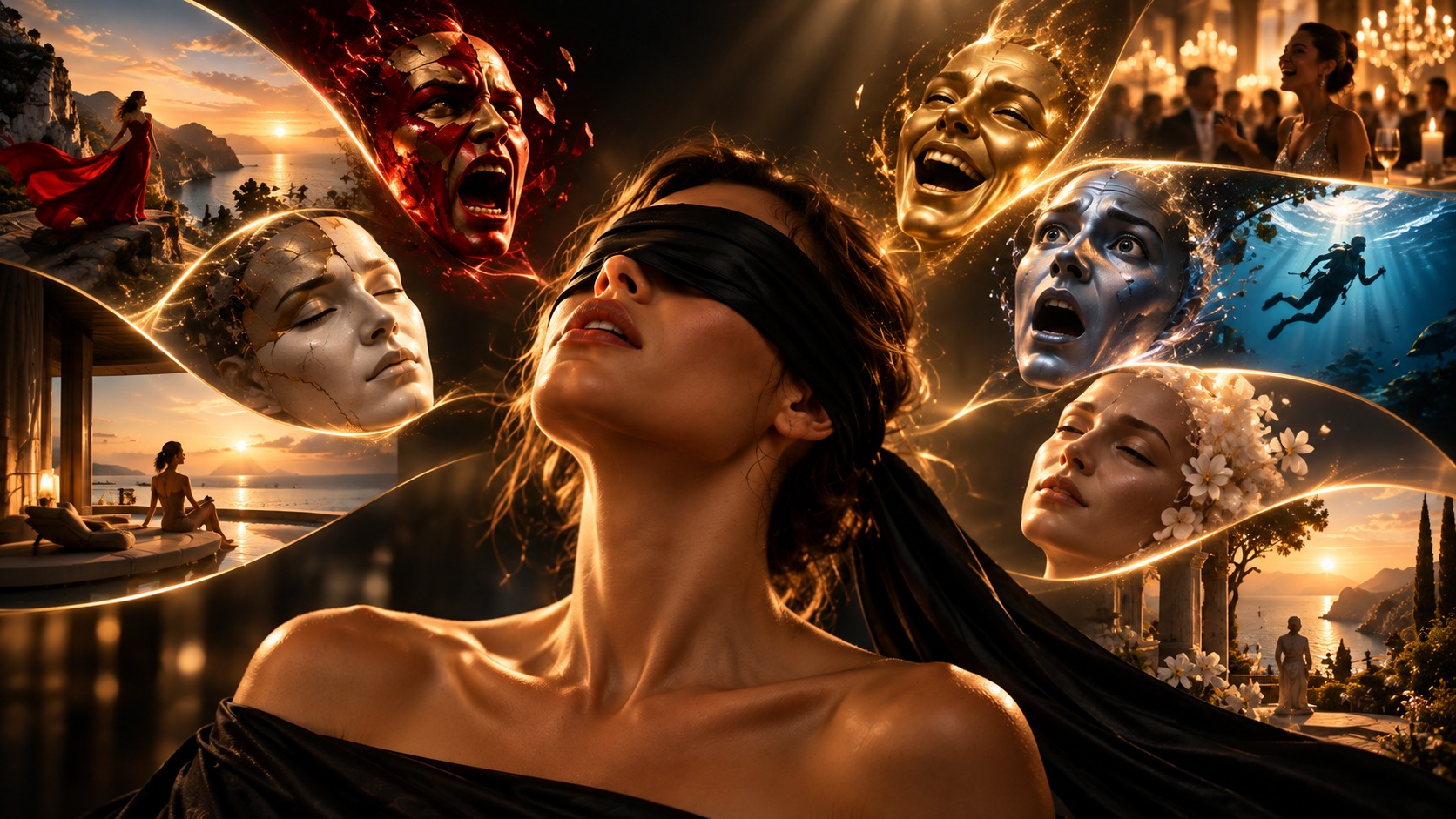 FIVE is the experiential concept at the heart of LWFY PRIVÉ: five original experiences created for members, each built around a different emotional trigger.
The objective is not simply to entertain, impress or add another layer of exclusivity.
It is to interrupt the familiar.
To create a moment outside the expected rhythm of everyday life — and perhaps reawaken emotions that have become increasingly rare.
An unexpected place, an unusual setting, an encounter, art, nature, silence, anticipation, surprise or a sudden change of rhythm can all become the starting point.
But FIVE is built around one fundamental principle:
We create the experience, not the emotion.
The experience can be designed.
The emotion cannot.
FIVE does not determine in advance what a participant should feel. Instead, it creates the conditions in which a personal and spontaneous response can emerge: curiosity, surprise, resistance, excitement, wonder, freedom, desire.
The same experience may therefore provoke an entirely different response in each person. That unpredictability is not a flaw in the concept. It is the point.
And this distinction becomes particularly relevant in the age of artificial intelligence.
As algorithms become increasingly sophisticated at predicting our tastes, choices and behaviours, FIVE deliberately preserves a space for what cannot be fully anticipated.
Because perhaps the most precious emotion is precisely the one that cannot be ordered, programmed or reproduced.
This is where LWFY PRIVÉ and FIVE connect experiential luxury with the broader philosophy of Neuro-Luxury: moving beyond personalisation based only on what people already know they like, towards experiences capable of introducing discovery, surprise and unexpected desire.
The ambition is therefore not to create “more luxury”.
It is to explore a different form of luxury:
one measured not only by access, rarity or privilege, but by what an experience is capable of awakening within us.
To discover LWFY PRIVÉ and explore FIVE, its five original experiences and its approach to emotional and experiential luxury, contact us.
And one question remains:
In a world where almost everything can be bought — and increasingly predicted — what must we still invent to make ourselves truly feel?
THE BIRKIN IS NOT DISAPPEARING. BUT OUR DEFINITION OF LUXURY IS CHANGING
Will wellness retreats, experiential luxury and Slow Luxury replace the Birkin bag?
Probably not.
Objects and experiences satisfy different forms of desire. Exceptional objects can carry extraordinary emotional, cultural and patrimonial value — and the pleasure of owning something rare, beautifully made or historically significant is unlikely to disappear.
The deeper transformation lies elsewhere:
our definition of luxury is expanding.
Ownership remains a pleasure.
Feeling becomes a privilege.
And artificial intelligence may paradoxically accelerate this shift.
The better AI becomes at anticipating our tastes, personalising our choices and shortening the distance between desire and satisfaction, the more valuable what escapes prediction may become.
The unexpected.
The surprise.
The disruption.
The coup de cœur.
That inexplicable emotion that suddenly makes us reconsider what we thought we wanted.
For the luxury industry, this could have significant implications.
In luxury real estate, hospitality, art, travel and personalised experiences, the question may increasingly move beyond simply delivering perfection or responding to known preferences.
Tomorrow, when confronted with an exceptional property, a hotel, a work of art or an experience, the essential question may no longer simply be:
“Is it luxurious enough?”
Or even:
“Is this exactly what I was looking for?”
But rather:
“Does this make me feel something I did not expect?”
Because the frontier of luxury may once again be shifting — from possession to experience, from experience to emotion, and perhaps ultimately from predictable desire to the unexpected desire we did not know we had.
Yesterday, we desired what was difficult to possess.
Tomorrow, we may seek what is still capable of surprising us.
And in a world increasingly shaped by algorithms, personalisation and prediction, what if luxury’s next great scarcity is ultimately neither an object nor even an experience, but something far more intimate:
our capacity to still feel the unexpected?
That is the territory we call Neuro-Luxury.
FAQ — NEURO-LUXURY, EMOTION AND THE FUTURE OF LUXURY
WHAT IS NEURO-LUXURY?
Neuro-Luxury explores how luxury interacts with emotion, perception, memory and desire. Beyond price, scarcity and status, it asks a fundamental question: why do certain places, objects, works of art or experiences leave us indifferent, while others create an immediate emotional connection — or even awaken a desire we did not know we had?
At its core, Neuro-Luxury examines the shift from what luxury allows us to own to what luxury makes us feel.
WHY IS EMOTION BECOMING A NEW FORM OF SCARCITY IN LUXURY?
As luxury goods, destinations and experiences become increasingly visible and reproducible, genuine personal emotion remains difficult to standardise.
A memorable experience, an unexpected encounter or a property that triggers an immediate coup de cœur cannot be reproduced in exactly the same way for another person.
This irreproducible emotional dimension may therefore become one of the defining forms of exclusivity in contemporary luxury.
WILL EXPERIENTIAL LUXURY REPLACE TRADITIONAL LUXURY GOODS?
Probably not.
High jewellery, fine watches, collectible cars, art, exceptional real estate and iconic handbags will continue to inspire desire and retain cultural, emotional and financial value.
Experiential luxury expands rather than replaces the traditional definition of luxury. For high-net-worth and ultra-high-net-worth individuals, experiencing something rare, personal and emotionally memorable may increasingly become as meaningful as owning an exceptional object.
WHY ARE WELLNESS AND SLOW LUXURY BECOMING MORE IMPORTANT?
In a world shaped by acceleration, screens, constant stimulation and information overload, time, calm, nature, privacy and disconnection are acquiring new value.
Luxury wellness, private retreats and Slow Luxury respond to this search for space, time and reconnection.
But wellbeing does not necessarily mean silence or rest. For some people, it may come from beauty, discovery, surprise, wonder or emotional intensity.
The deeper luxury may therefore lie in finding the environment capable of responding to what we emotionally need at a particular moment.
CAN ARTIFICIAL INTELLIGENCE CREATE DESIRE IN LUXURY?
Artificial intelligence can increasingly analyse behaviour, identify patterns in our tastes and anticipate our preferences.
But predicting preference is not necessarily the same as creating desire.
Human desire can emerge in response to something we would never have searched for: an unexpected property, a work of art that moves us, a destination we had never considered or an experience that falls outside every criterion we had previously defined.
As AI makes luxury increasingly personalised and predictable, surprise and unexpected desire may become more valuable precisely because they remain difficult to anticipate.
This territory between prediction, emotion and desire may become one of the defining frontiers of Neuro-Luxury.
NEURO-LUXURY BY LUXURY WORLD FOR YOU
Tomorrow’s luxury may no longer be measured only by what we can acquire, but by our capacity to still feel the unexpected — and the emotion that awakens desire.


