
Where Global Capital Is Moving in 2026 — Strategy, Wealth Structuring & Access to Luxury Assets

This article explores where global capital is moving in 2026, how it is structured, and how high-net-worth investors access off-market opportunities across luxury real estate and strategic assets. In 2026, global capital is becoming more mobile, structured, and access-driven. High-net-worth individuals are prioritizing multi-jurisdictional wealth structuring, off-market investments, and private networks over traditional lifestyle assets. Concepts like Matryoshka 2.0, a multi-layered structuring model, are emerging to optimize tax efficiency, asset protection, and discretion. Luxury real estate and strategic assets now serve as tools for capital preservation, diversification, and global positioning, with key hubs including Dubai, Monaco, and Singapore.
The Shift: From Lifestyle Luxury to Strategic Capital Allocation
 Luxury has changed.
So has capital.
Luxury real estate is no longer just a lifestyle statement—it has become a core component of global investment strategy. The acquisition of prestigious properties is no longer driven solely by aesthetics, status, or personal enjoyment. Instead, in 2026, it reflects a deeper logic: capital positioning, wealth preservation, and international portfolio diversification.
Today, prime real estate sits at the intersection of multiple strategic layers:
- international wealth structuring across jurisdictions
- global capital allocation aligned with macroeconomic shifts
- jurisdictional optimization for tax efficiency and regulatory flexibility
- asset protection strategies designed to secure long-term value
Global capital flows are not declining—they are transforming.
In an environment shaped by geopolitical tensions, evolving regulatory frameworks, and the accelerating globalization of high-net-worth individuals (HNWIs), capital is undergoing a profound shift.
It is becoming:
- more mobile, moving rapidly between key financial hubs such as Dubai, Singapore, and Monaco
- more structured, relying on multi-layered legal and financial architectures
- more discreet, operating beyond traditional public markets
Increasingly, off-market real estate transactions, private investment networks, and exclusive deal flow access define how high-value assets are exchanged.
In this new paradigm, visibility is no longer the key driver of value.
Access is.
Understanding luxury in 2026 means understanding how global capital is strategically deployed—across borders, across asset classes, and across private ecosystems where the most significant opportunities are no longer publicly visible.
Slow Luxury: The New Investment Logic of the Ultra-Wealthy
In a constantly evolving geopolitical environment, capital does not vanish.
It redeploys.
The number of billionaires continues to rise—now exceeding 3,000 globally—and is projected to approach 4,000 by 2031, largely driven by technology, artificial intelligence, and the acceleration of private markets (sources: Forbes, UBS, PwC).
At the same time, global private wealth has reached over $450 trillion in 2025, with high-net-worth individuals (HNWIs) controlling an increasing share of cross-border investments (source: Boston Consulting Group).
But beyond this expansion, the real transformation is not quantitative.
It is structural.
Today, global capital is:
- faster to accumulate, fueled by exponential growth in tech, AI, and digital ecosystems
- global in scope, with investments spanning multiple jurisdictions simultaneously
- strategic in allocation, driven by risk diversification, tax efficiency, and access to exclusive opportunities
This structural evolution marks a clear departure from traditional investment logic.
It introduces a new paradigm: Slow Luxury.
More than a trend, Slow Luxury is a high-level investment philosophy adopted by the world’s most sophisticated investors. It prioritizes:
- stability over speculation — focusing on resilient assets in politically and economically stable environments
- selectivity over volume — privileging rare, high-quality, and often off-market assets
- access over visibility — leveraging private networks, family offices, and exclusive deal flow
In this context, value is no longer created through exposure—but through controlled access to global opportunities.
Slow Luxury reflects a deeper shift in wealth management:
from rapid acquisition → to strategic positioning
from visible ownership → to discreet capital structuring
It is within this framework that luxury real estate, trophy assets, and global investment ecosystems take on their full strategic dimension in 2026.
Global Capital Trends in 2026: Mobility, Structuring and Discretion
 Capital Mobility Is Redefining Global Flows
Several key trends are reshaping capital movement:
- Over 1,500 Russian millionaires have recently relocated their wealth structures
- Middle Eastern capital is expanding globally through sovereign funds and family offices
- India is producing a new generation of globally oriented investors
But these visible movements are only part of the story.
The real transformation lies in how capital is structured, protected, and deployed.
Russian Capital Repositioning: From Visibility to Strategic Access
Since 2022, Russian capital has not disappeared—it has repositioned.
In 2026, capital flows are increasingly redirected toward strategic hubs such as:
- Dubai
- Istanbul
- Singapore
These jurisdictions offer a highly attractive combination of:
- regulatory flexibility, enabling adaptive wealth structuring
- confidentiality, aligned with the growing demand for discretion
- global market access, connecting investors to international deal flow
This shift reflects a broader transformation in global capital mobility, where speed, adaptability, and jurisdictional arbitrage have become essential.
At the same time, Europe remains a key destination—but in a more discreet form.
Prestige markets such as:
- Monaco
- London
- French Riviera
continue to attract significant high-net-worth capital, particularly in luxury real estate.
However, acquisitions are increasingly structured through:
- indirect ownership structures (holding companies, layered entities)
- international investment vehicles
- alternative residency and tax frameworks
This allows investors to maintain exposure to Europe’s most stable and prestigious assets while optimizing tax efficiency, asset protection, and privacy.
The fundamental shift is no longer about where capital flows.
It is about how it accesses opportunities.
In 2026, access-driven investment strategies, off-market transactions, and private networks define the real dynamics of international wealth deployment—marking a decisive move from visible ownership to strategic, structured, and discreet capital positioning.
Toward Structured and Selective Capital
A new paradigm is reshaping global capital allocation in 2026—one defined by precision, discretion, and strategic architecture rather than scale or visibility.
Three major evolutions now structure the behavior of high-net-worth capital:
- multi-jurisdictional structuring — investors increasingly deploy layered entities across key hubs such as Dubai, Singapore, and Monaco to optimize taxation, enhance asset protection, and ensure regulatory flexibility
- advanced diversification across asset classes — portfolios are no longer limited to traditional holdings but integrate luxury real estate, private equity, tangible assets, and emerging vehicles such as tokenized investments, creating resilient and globally balanced allocations
- growing reliance on private networks and off-market access — a significant share of high-value transactions now occurs outside public channels, within family offices, private investment circles, and curated ecosystems where access is restricted and highly selective
As a result, capital is becoming more agile, more structured, and fundamentally more strategic.
But it is also becoming increasingly difficult to access.
In this environment, opportunity is no longer driven by visibility or volume.
It is determined by entry points—the ability to connect with the right networks, the right jurisdictions, and the right deals before they reach the public market.
This marks a decisive shift from open-market investing to access-driven capital deployment, where selection, structure, and network proximity define long-term value creation.
Matryoshka 2.0: The Global Standard for Wealth Structuring
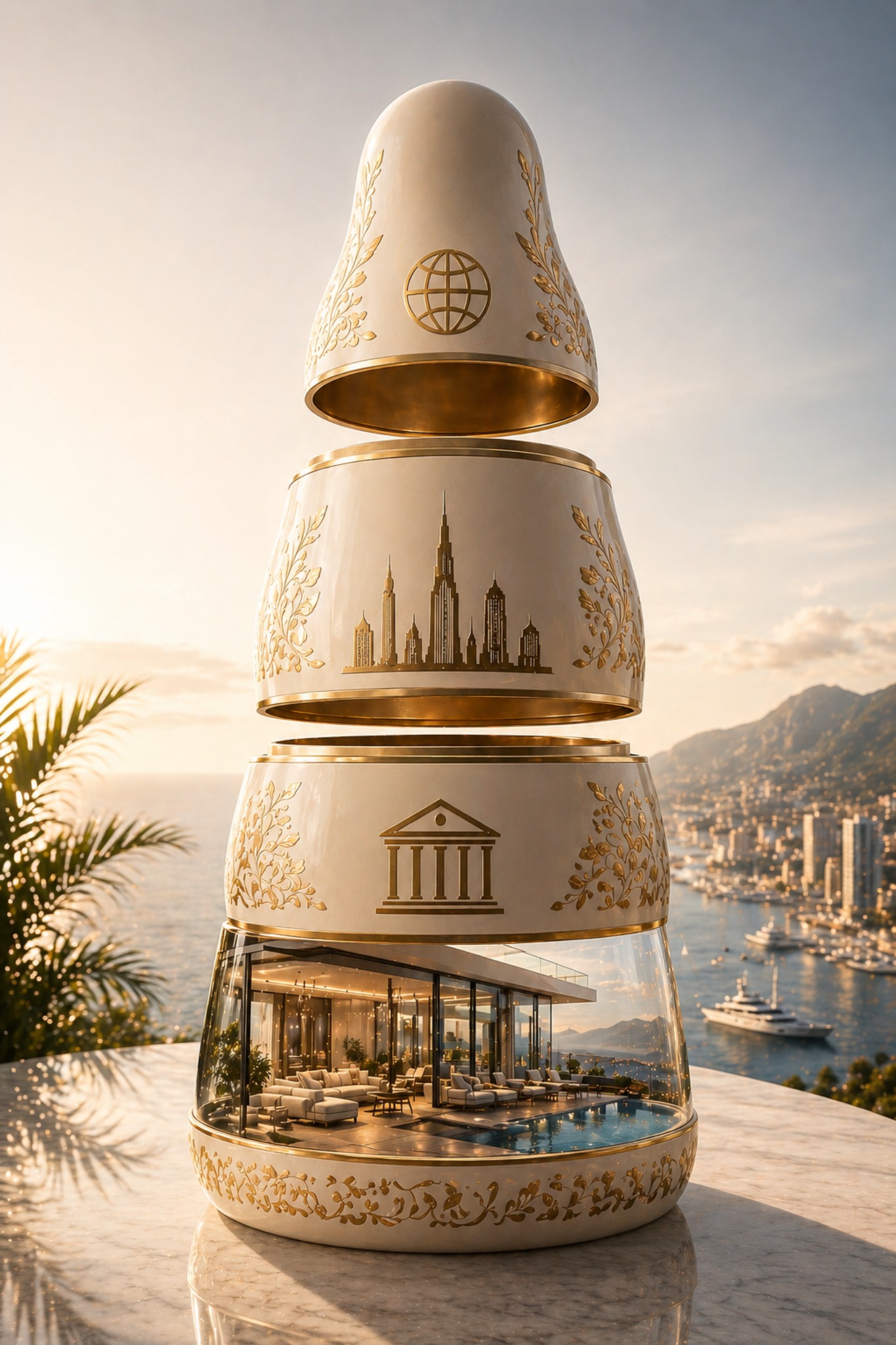 Matryoshka 2.0 has emerged as a leading model in international wealth structuring, redefining how global capital is organized, protected, and deployed across jurisdictions.
Inspired by the concept of nested Russian dolls, this approach is built on layered legal and financial structures, combining:
- holding companies
- intermediary entities
- specialized investment vehicles
This multi-layered architecture enables assets to be:
- optimized for tax efficiency and regulatory alignment
- protected against legal, political, and financial risks
- discreetly held, ensuring a high level of confidentiality
In practice, a luxury real estate asset located in prime markets such as Monaco or London may be owned through a holding structure based in Dubai or Singapore, itself integrated into a broader multi-jurisdictional framework.
This structure allows investors to:
- enhance asset protection strategies
- facilitate wealth transmission across generations
- maintain capital mobility in a rapidly changing global environment
Originally associated with Eastern European capital strategies in the 1990s, the Matryoshka model has evolved significantly.
Today, it is widely adopted by:
- international family offices
- Middle Eastern investors
- Asian wealth structures
This evolution reflects a profound shift in global wealth management:
from confidential financial engineering → to a recognized international standard
In 2026, the value of an asset is no longer defined solely by its location or prestige, but by how it is structured, integrated, and positioned within a global capital ecosystem.
Matryoshka 2.0 embodies this transformation—where structure becomes strategy, and where discretion, flexibility, and cross-border optimization define the new rules of wealth.
The Role of Crypto Assets in 2026 Wealth Structuring
Crypto assets are no longer speculative instruments on the fringe of finance.
In 2026, they are fully integrated into global capital architecture, playing a strategic role in wealth structuring, capital mobility, and cross-border allocation.
They now function as:
- liquidity layers, enabling immediate access to capital across jurisdictions
- transfer mechanisms, facilitating efficient and borderless transactions
- strategic reserve assets, complementing traditional holdings within diversified portfolios
Within a Matryoshka-style multi-jurisdictional structure, crypto assets introduce a new dimension of performance and adaptability. They enhance:
- flexibility, allowing dynamic allocation between markets and asset classes
- speed, reducing friction in capital deployment and rebalancing
- jurisdictional agility, enabling investors to navigate regulatory environments more efficiently
This integration unlocks several key advantages:
- rapid capital movement across global financial hubs such as Dubai and Singapore
- access to tokenized assets, including tokenized real estate, private equity, and alternative investments
- participation in digital private markets, where early-stage and off-market opportunities are increasingly structured on blockchain infrastructure
In this context, crypto assets act as an accelerator of global investment strategies, bridging traditional finance with emerging digital ecosystems.
They do not replace existing structures such as holdings or investment vehicles.
They enhance them—adding a discreet, highly efficient layer to international wealth structuring.
Aligned with the principles of Slow Luxury—discretion, control, and strategic access—crypto becomes a critical tool for investors seeking to combine security, mobility, and opportunity in a rapidly evolving global landscape.
What Types of Luxury Real Estate Are Sought After in 2026?
 In 2026, luxury real estate is no longer about owning a single exceptional property.
It is about orchestrating a global footprint of capital.
Wealth is now structured around a refined triad:
- a primary residence in a stable and secure environment
- a strategic base in a global hub
- a liquid asset in a high-demand international market
Luxury is no longer where you live.
It is where your capital is positioned.
A Global and Strategic Investment Logic
In this new paradigm, prime real estate evolves beyond a tangible asset.
It becomes a central pillar of:
- international wealth diversification
- jurisdictional optimization
- access to elite global ecosystems
The most valuable properties are no longer defined by visibility—
but by their ability to connect capital to opportunity.
For a deeper and more operational perspective:
➡️ Discover our full analysis: International Luxury Real Estate in 2026 — The Luxury Nomad Kit™ Strategy
The Most Sought-After Luxury Property Types
Today’s high-net-worth investors prioritize assets that combine security, services, and global connectivity:
- serviced luxury apartments
→ offering concierge, security, and seamless asset management - secure private villas
→ ensuring discretion, exclusivity, and controlled environments - properties in globally connected hubs
→ located near financial centers, private aviation, and international networks
A property is no longer just a place.
It is an interface between capital and the world.
Ultra-Prime Assets: Where Strategy Meets Prestige
Some properties perfectly embody this evolution toward strategic luxury real estate:
- Apartment at the Tour Odéon in Monaco
→ an iconic residence combining ultra-prime positioning, exclusive services, and global appeal - The Charles Penthouse in New York
→ a rare asset where absolute exclusivity meets long-term capital preservation - A New York penthouse
→ a gateway into ultra-luxury living within one of the world’s most liquid real estate markets
These are not just properties.
They are strategic anchors in the architecture of global wealth.
From Ownership to Strategic Positioning
This evolution reflects a fundamental shift:
Investors are no longer buying properties.
They are securing positions within the global capital landscape.
Luxury real estate has become:
- a global anchor
- a diversification tool
- a gateway to influence and networks
In 2026, the question is no longer “Where do you live?”
But “Where is your capital strategically positioned?”
In a world where access outweighs visibility,
the most sought-after assets are those that offer more than prestige:
They offer strategy.
They offer protection.
They offer access to the invisible layer of global capital.
Integrated Allocation: Yield Meets Network
Luxury real estate is no longer a standalone investment.
It is part of a global capital allocation strategy.
Today’s high-end portfolios are designed to combine performance, resilience, and access—blending assets that generate both financial returns and strategic connections.
They typically integrate:
- trophy residential assets
→ Step into our in-depth analysis of the real estate market in Monaco - targeted rental investments
→ Explore our strategic reading of the market in Marbella - properties embedded in premium ecosystems
(golf estates, luxury resorts, serviced residences)
→ Discover our analysis: Private Golf & Slow Luxury — The New Signature of Modern Luxury, Investment & Relational Capital
The objective is clear:
to secure capital while gaining access to high-value environments where wealth, influence, and opportunity converge.
Strategic Assets at the Intersection of Lifestyle and Performance
➡️ Explore our high-potential investment opportunities
- Exceptional golf villa in a prime location, ideally positioned in the heart of Nueva Andalucía, within Marbella’s prestigious Golf Valley
→ where location meets long-term value creation - Iconic penthouse in London
→ offering breathtaking panoramic views over the Thames, Westminster, and the London Eye
→ where heritage, liquidity, and global appeal intersect - Luxury villa at Anahita Golf & Spa Resort in Mauritius
→ with golf and beach access, combining lifestyle excellence with strong rental yield potential
From Property Acquisition to Capital Positioning
This evolution reflects a fundamental reality:
Investors are no longer looking for properties.
They are seeking strategic capital positioning.
A property is no longer just an asset.
It is a gateway.
A gateway to:
- global networks
- exclusive ecosystems
- long-term value creation
In 2026, the true value of luxury real estate lies not only in what you own—
but in where it positions your capital, and who it connects you to.
Billionaire Geography: The Decoupling of Wealth and Territory
 Global Ranking Still Concentrated
In 2026, global wealth remains structurally concentrated in a handful of economic powerhouses:
- United States
- China
- India
- Germany
- Russia
The United States alone accounts for 800+ billionaires, maintaining a dominant position driven by technology, finance, and private equity ecosystems. China follows with 400–500 billionaires, while India has surpassed 200+ billionaires, making it one of the fastest-growing wealth markets globally (sources: Forbes, Bloomberg).
Yet this geographic reading is increasingly outdated.
Wealth may be created locally—
but it is no longer held locally.
Structural Shift: From Location to Mobility
A profound transformation is redefining the logic of global wealth allocation:
capital is no longer tied to a single territory.
An increasing number of billionaires are:
- relocating their residency or operational bases
- structuring assets internationally across multiple jurisdictions
- investing globally through diversified and mobile portfolios
This shift is fueled by:
- regulatory fragmentation
- tax optimization strategies
- geopolitical uncertainty
- the rise of borderless investment opportunities
As a result, new global capital hubs are emerging as central nodes of wealth structuring:
- Dubai
- Monaco
- Singapore
These jurisdictions offer a powerful combination of:
- tax efficiency
- regulatory stability
- high-level international connectivity
The map of wealth is no longer defined by borders—
but by access.
India: Growth Engine and Emerging Capital Relocation
India perfectly illustrates this new dynamic.
With one of the highest growth rates in billionaire creation, the country is becoming a major force in global wealth generation, supported by:
- digital transformation
- infrastructure expansion
- industrial and tech conglomerates
According to UBS, India is expected to see one of the fastest increases in high-net-worth individuals (HNWIs) over the next decade.
Yet alongside this growth, a more discreet trend is emerging:
the partial relocation of wealth structures.
An increasing number of Indian ultra-high-net-worth individuals are:
- establishing holding entities abroad
- diversifying jurisdictional exposure
- accessing international financial ecosystems
Primary destinations include:
- Singapore
- Dubai
The objective is clear:
- greater flexibility
- enhanced access to global investments
- optimized legal and tax structuring
India is no longer just a creator of wealth.
It is becoming a key player in the global redistribution of capital.
The Next 10 Years: A New Face of Billionaires
Looking ahead to 2035, the transformation accelerates.
According to projections from UBS and PwC:
- the number of billionaires could exceed 4,000 globally
- over 60% of new wealth creation is expected to come from technology, AI, and digital platforms
- Asia could represent 40%+ of global billionaire growth
But the most important shift is not numerical.
It is generational.
The face of wealth is changing.
A new class of billionaires is emerging:
- younger
- more global
- digitally native
These next-generation wealth creators are:
- founders of AI, fintech, and platform economies
- less attached to physical territories
- more inclined toward mobile, liquid, and scalable assets
Their investment behavior reflects this shift:
- preference for global real estate hubs over national markets
- integration of digital assets and tokenized investments
- reliance on private networks and direct deal access
They do not inherit systems.
They redesign them.
Examples of Globalized Wealth
This new geography of capital is already embodied by some of the world’s most influential figures:
- Mukesh Ambani
→ leveraging global partnerships and attracting international capital into India - Gautam Adani
→ expanding aggressively into global infrastructure and energy markets - Elon Musk
→ operating a fully multi-continental capital model, detached from any single geography - Bernard Arnault
→ building a luxury empire with deep exposure across Europe, the U.S., and Asia - Roman Abramovich
→ illustrating complex wealth relocation and jurisdictional diversification strategies
A New Reading of Global Wealth
This evolution reveals a fundamental shift:
- wealth creation, structuring, and investment now occur in different locations
- capital flows are increasingly transnational and network-driven
- access to the right ecosystems outweighs geographic origin
The question is no longer where billionaires are.
It is how their capital moves—and where it is positioned.
In this new paradigm, mobility replaces geography,
and strategy replaces location as the true driver of global wealth.
Yachts & Slow Luxury: The New Strategic Asset of Global Billionaires
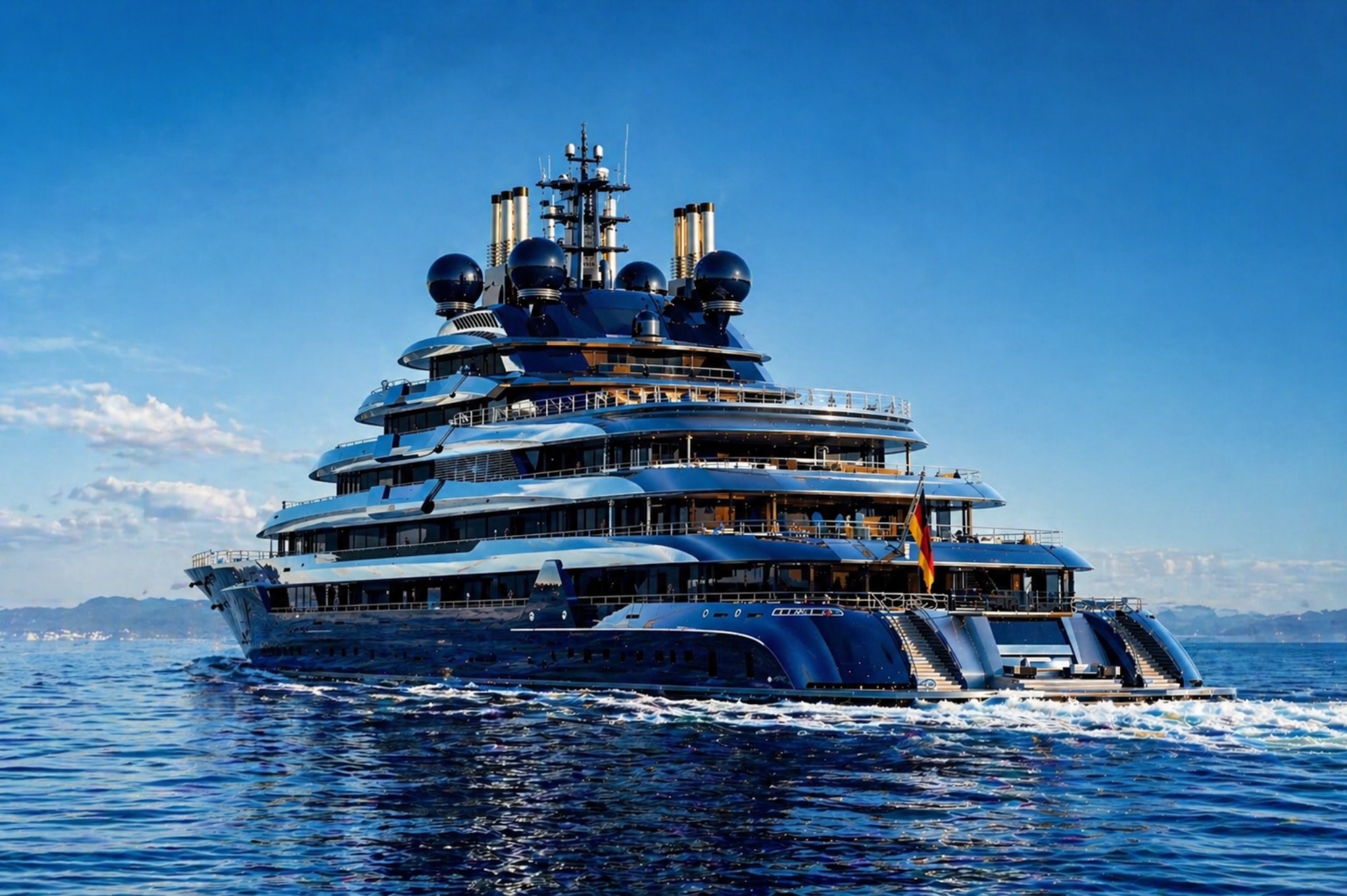 From Static Real Estate to Mobile Assets: A Transformation of Luxury Capital
In an era defined by the increasing mobility of global wealth, a new generation of billionaires is redefining the codes of international luxury investment.
More mobile.
More global.
Less attached to a single residence.
These profiles are now prioritizing flexible, liquid, and strategic assets.
Luxury is no longer anchored.
It moves.
Yachts: The Rise of a Hybrid Asset Class
Yachts have emerged as a powerful hybrid asset class, positioned at the intersection of:
-
luxury real estate
-
high-end lifestyle
-
global wealth management
Far beyond a symbol of prestige, they have become:
-
private networking platforms
-
mobile residences
-
capital optimization tools
Capable of navigating seamlessly between key global hubs such as Monaco, Dubai, and Singapore, yachts embody a new investment logic built on:
-
mobility
-
access
-
discretion
A yacht is no longer just owned.
It is strategically deployed.
From Ownership to Strategic Mobility
This evolution confirms a major shift in global capital allocation:
from static assets → to mobile assets
At the heart of the Slow Luxury philosophy, yachts are now seen as:
-
instruments of capital flexibility
-
vehicles of global positioning
-
gateways to exclusive international networks
They combine:
-
yield potential (charter, value retention)
-
experiential luxury
-
access to high-level ecosystems
In 2026, mobility is not a feature.
It is a strategy.
Luminance: A Floating Symbol of Strategic Luxury
A “Floating Villa” with Ultra-High Strategic Value
The Luminance, associated with Rinat Akhmetov, does more than embody luxury—
it redefines its purpose.
Delivered in 2024 by the German shipyard Lürssen, this ~145-meter superyacht, valued at over $500 million, represents a new generation of mobile capital assets designed to move with wealth.
Designed for Autonomy, Influence, and Discretion
On board, every detail is engineered to combine:
-
autonomy
-
confidentiality
-
influence
Accommodating around 20 guests with a world-class crew, Luminance offers an infrastructure comparable to a private sovereign micro-territory:
-
dual helipads for seamless global access
-
infinity pools facing the horizon
-
spa, beach club, private cinema
-
expansive entertainment and negotiation spaces
Each element is conceived as an extension of power, comfort, and control.
Designed by Espen Øino, its contemporary architecture emphasizes:
-
fluid volumes
-
clean lines
-
a sense of total freedom
Beyond Luxury: A Global Private Platform
But beyond its features, Luminance reveals a deeper strategic reality:
It is a fully mobile, secure, and autonomous asset capable of becoming:
-
a private residence
-
a negotiation hub
-
a representation space
-
a strategic retreat
More than a yacht—
it is a global private platform.
A platform designed to evolve with its owner,
in sync with opportunities, capital flows, and geopolitical dynamics.
Strategic Yacht Assets in the Slow Luxury Era
➡️ Explore our exclusive selection of luxury yachts — strategic assets at the core of international Slow Luxury
-
MAR Yacht
→ the ultimate expression of contemporary yachting, combining avant-garde design, cutting-edge technology, and modular living spaces conceived as a private residence at sea -
O’PTASIA Yacht
→ an icon of exceptional yachting, blending refined lines, expansive volumes, immersive spa experiences, and sophisticated reception areas dedicated to an exclusive lifestyle -
La Datcha
→ an extraordinary explorer yacht, designed for extreme expeditions, featuring long-range autonomy, helipad, full spa facilities, and the ability to navigate from polar regions to the most remote destinations in absolute comfort
The New Logic of Luxury Capital
This transformation reveals a fundamental truth:
Investors are no longer seeking static assets.
They are building mobile, strategic ecosystems of capital.
The yacht becomes:
-
a moving asset
-
a networking platform
-
a symbol of strategic freedom
In the age of Slow Luxury:
capital no longer stays.
It moves, connects, and positions itself globally.
FAQ — Global Capital, Luxury Real Estate & Investment Strategies in 2026
Where is global capital heading in 2026?
Global capital is increasingly flowing toward strategic financial hubs such as Dubai, Monaco, and Singapore. These locations offer a powerful mix of tax efficiency, regulatory stability, and global connectivity, making them key centers for international wealth structuring.
Why are high-net-worth individuals changing their investment strategies?
Today’s ultra-wealthy investors are adapting to:
- geopolitical uncertainty
- evolving tax regulations
- globalized investment opportunities
As a result, they are shifting toward multi-jurisdictional strategies, off-market investments, and private networks, prioritizing access over visibility.
What are the most sought-after luxury real estate assets in 2026?
Investors are targeting properties that combine security, liquidity, and strategic positioning, including:
- serviced luxury apartments
- secure private villas
- properties in global hubs (financial centers, resort ecosystems, connected destinations)
These assets are no longer just lifestyle choices—they are tools for capital allocation and wealth preservation.
What is “Slow Luxury” in investment terms?
Slow Luxury is an investment philosophy based on:
- stability over speculation
- selectivity over volume
- access over visibility
It reflects a shift toward long-term value creation, discreet ownership, and strategic positioning of global capital.
Why is luxury real estate still a key strategic asset?
Luxury real estate remains essential because it:
- anchors capital in stable jurisdictions
- preserves long-term value
- provides access to global networks and influence
It has evolved from a lifestyle asset into a core component of international wealth strategy.
Why are more luxury real estate transactions happening off-market?
A growing share of high-value transactions is conducted off-market because:
- buyers demand confidentiality
- prime assets are rare and highly selective
- private networks enable targeted access
In today’s market, access matters more than visibility.
What role do yachts play in wealth strategy?
Yachts are emerging as strategic mobile assets because they offer:
- global mobility
- privacy and discretion
- exclusive networking environments
They complement real estate by adding a mobile dimension to capital positioning within the Slow Luxury ecosystem.
How are crypto assets integrated into wealth structuring in 2026?
Crypto assets are now used as:
- liquidity tools
- cross-border transfer mechanisms
- strategic portfolio components
They enhance traditional structures by enabling faster, more flexible global capital movement.
Is the geography of billionaires still relevant?
Less and less.
While wealth is still created in major economies, it is now:
- structured internationally
- held across multiple jurisdictions
- deployed globally
Figures like Elon Musk and Bernard Arnault illustrate a new reality:
wealth is no longer tied to a single country—it is globally positioned.
What will global wealth look like in the next 10 years?
By 2035:
- the number of billionaires could exceed 4,000 globally
- technology and AI will drive the majority of new wealth creation
- Asia is expected to represent a growing share of global capital
A new generation of younger, globally mobile, tech-driven billionaires will dominate the landscape.
How can investors access high-end off-market opportunities?
The most strategic opportunities are rarely public.
They are accessed through:
- private networks
- family offices
- curated platforms and ecosystems
Access is the new currency of luxury investment.
Why is access more important than visibility in 2026?
Because the most valuable assets are:
- not publicly listed
- highly selective
- distributed through private channels
Visibility shows what exists.
Access reveals what matters.
Luxury Investment 2026: Access Over Visibility
 Luxury has changed.
So has capital.
In 2026, high-net-worth individuals no longer think in terms of acquisition—
they think in terms of global investment strategy.
Luxury real estate, mobile assets such as yachts, and international hubs are no longer status symbols.
They have become capital structuring tools, designed to serve:
- mobility
- security
- strategic access
The question is no longer simply:
Where should you invest?
But rather:
Where is global capital positioning itself—and how do you access it?
A New Investment Paradigm
In this new landscape:
- visibility loses value
- access becomes decisive
- strategy prevails over lifestyle
The most sophisticated investors are no longer searching for visible opportunities.
They operate within private, international, and highly selective ecosystems.
The most valuable assets are not the most visible ones—
they are the most strategically positioned.
Understanding these dynamics means:
- anticipating global capital flows
- identifying emerging investment hubs such as Dubai, Monaco, and Singapore
- positioning capital where value is truly created
Luxury World For You: From Visibility to Access
This is precisely where Luxury World For You becomes relevant.
The real transformation lies elsewhere.
Today, high-value transactions are no longer driven by visibility.
They are driven by access.
A significant share of premium buyers:
- operate internationally
- are highly mobile
- move within private, structured, and discreet networks
Which leads to one essential question:
Are your properties truly visible… or simply listed?
More Than a Platform—An Ecosystem
Luxury World For You is not a portal.
It is not just a network.
It is an ecosystem.
An ecosystem designed around:
- access to qualified international demand
- selective exposure
- global capital circulation
Connected directly with:
- family offices
- private investors
- strategic decision-makers
A New Standard of Positioning
- targeted exposure
- global audience
- strategic positioning
We collaborate with a limited number of agencies offering exceptional properties that require:
- precision
- discretion
- privileged access
Final Insight
Luxury is no longer about being seen.
It is about being accessed.
If you are marketing properties that demand this level of positioning:
Join Luxury World For You
and connect with a truly qualified international demand.


